Bet Builders Versus Traditional Accumulators: Weighing Customization in Football Markets

Football betting markets have expanded considerably over recent seasons, and observers note that bet builders alongside traditional accumulators represent two distinct approaches that continue to shape how participants structure their wagers. Data from multiple operators shows both formats attract substantial volume during peak periods, including the European club campaigns that stretch into June 2026 when international qualifiers and domestic cup finals overlap. Researchers tracking platform activity find that customization options influence selection patterns, yet the underlying mechanics of each product determine payout structures and risk profiles in measurable ways.
How Traditional Accumulators Function in Football Markets
Traditional accumulators combine multiple independent selections into a single bet, and each correct outcome multiplies the odds to produce the final return. Operators record these wagers as popular choices for major matchdays because they require relatively straightforward inputs such as match results, both teams to score, or over/under goal totals. Studies from academic institutions indicate that accumulators maintain steady participation rates across leagues because the format rewards accurate forecasting across several fixtures without requiring additional parameter adjustments. When one leg fails the entire stake is lost, which creates a clear risk-reward dynamic that data providers quantify through settlement statistics released at the end of each season.
Mechanics and Features of Bet Builders
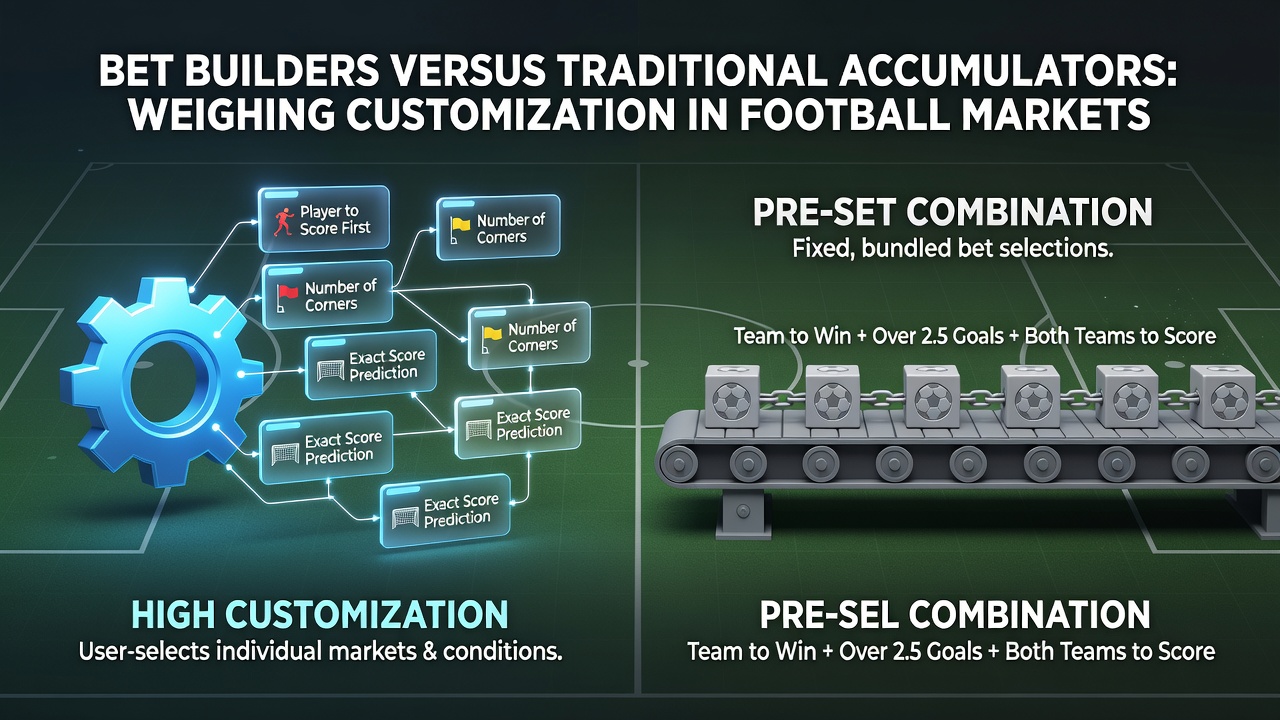
Bet builders allow users to assemble bespoke combinations from a single match or across several games, incorporating variables such as player shots, corner counts, card totals, and goal timings. Industry reports reveal that these tools generate higher engagement during high-profile fixtures because they accommodate granular preferences while still calculating combined odds in real time. Figures released by European gaming associations demonstrate that bet-builder usage rises when live data feeds update rapidly, enabling participants to refine selections as events unfold. The format differs from classic accumulators because selections remain tied to specific statistical thresholds rather than broad match outcomes alone.
Customization Levels and Their Market Impact
Customization depth varies significantly between the two products, and analysts from research centers across North America and Australia document how bet builders expand the range of available parameters. Participants can isolate individual player contributions or tactical elements, which alters the probability calculations that operators apply. In contrast, traditional accumulators rely on a narrower set of predefined markets, limiting the number of ways a wager can be constructed. Data collected during the 2025/26 campaign shows that markets with richer customization options experience increased bet volumes per fixture, particularly when multiple competitions run concurrently into the summer months of 2026.
Risk Distribution and Settlement Patterns
Risk profiles diverge because accumulators demand every selection to succeed for a return, whereas bet builders sometimes incorporate partial payout structures depending on operator rules. According to findings published by the National Center for Responsible Gaming in the United States, settlement data indicates that multi-leg accumulators produce lower overall success rates yet higher potential multipliers when all legs land. Bet builders distribute outcomes across more granular criteria, which can result in partial wins or losses on individual components. Observers tracking transaction volumes note that these differences affect how participants allocate stakes across an entire matchweek.
Operator Strategies and Platform Integration
Bookmakers integrate both formats into unified interfaces, and reports from the Australian Gambling Research Centre highlight how seamless switching between accumulator builders and traditional slips influences session length. Some platforms emphasize bet-builder promotions during specific tournament windows, while others maintain consistent accumulator bonuses across the calendar year. Evidence gathered from industry-wide surveys suggests that integration quality correlates with user retention metrics, especially when real-time statistics feed directly into the customization tools. The overlap between the two products allows operators to capture different segments without forcing exclusive choices.
Comparative Data on Participation Trends
Participation metrics compiled by various trade organizations reveal that accumulators continue to account for a substantial share of total football bets, yet bet-builder activity grows at a faster pace in markets where mobile interfaces dominate. When June fixtures coincide with international windows in 2026, analysts record spikes in both categories, although the distribution shifts depending on the availability of detailed player statistics. Research indicates that markets offering extensive customization see elevated engagement from users who previously favored simpler accumulator structures, suggesting gradual adaptation rather than outright replacement.
Conclusion
The coexistence of bet builders and traditional accumulators demonstrates how football betting markets accommodate varying preferences for customization and risk structure. Settlement records, platform analytics, and cross-regional studies collectively illustrate that each format serves distinct participant needs while operating within the same regulatory and technological environment. As data collection improves and additional statistical layers become accessible, the interplay between these products is expected to remain a central feature of football wagering landscapes.